





Abstract submission deadline
3rd ICEM
International Conference on Environmental Management
Water Security in a Changing Climate:
Scaling Nature-Based Solutions
Conference Day
October 22, 2026
Full Paper Submission Deadline
September 30, 2026
Publication
Welcome Remarks

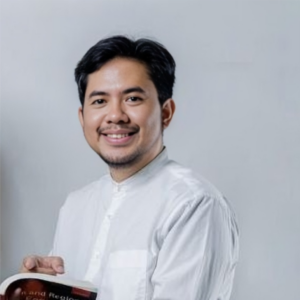
Dr. Evi Irawan
Chairman
Welcome to the Third International Conference on Environmental Management (ICEM 3rd). The main theme of this year is “Water Security in a Changing Climate: Scaling Nature-Based Solutions.”
This conference arrives at a critical moment. Climate change is altering rainfall patterns, intensifying droughts and floods, and increasing uncertainty in agriculture, energy, public health, urban systems, and ecosystems. Water security ensures sufficient quantity and quality at an affordable cost while minimizing risks to human well-being, economic activity, and environmental sustainability.
These challenges are interconnected. Water insecurity threatens food systems, livelihoods, health, and social stability, while millions—especially in vulnerable communities—lack access to safe drinking water and sanitation. Addressing these issues requires integrated, adaptive, and forward-looking responses. Nature-Based Solutions (NbS) offer a promising approach. Restoring wetlands, rehabilitating watersheds, managing soil and landscapes, and implementing blue-green urban infrastructure, NbS improve water quality, reduce disaster risks, enhance ecosystem resilience, and provide broad social, economic, and environmental benefits.
This conference brings together scholars, policymakers, practitioners, and development partners to exchange evidence, experiences, and strategies for scaling NbS. We hope this platform will foster collaboration and inspire practical action toward a more resilient and water-secure future.
Editorial Board
Committees
Steering Committee
Prof. Dr. Okid Parama Astirin, M.S.
Prof. Dr. Al. Sentot Sudarwanto, S.H., M.Hum.
Dr. Rahning Utomowati, S.Si., M.Sc.
Chairman
Dr. rer.agr. Evi Irawan, S.P., M.Sc.
Paper Administration, Plenary, and Thematic Sessions
Puguh Karyanto, S.Si., M.Si., Ph.D.
Dr. Anti Mayastuti, SH., M.H.
Dr. Siti Rachmawati, S.ST., M.Si.
Diah Apriani Atika Sari, S.H., LL.M.
Logistics
Ensinasawor Dea Pratiwi, S.Si.
Hadi Wiwit Hendro Cahyono, S.Pd.
Muhammad Zulfi, S.Pd.
Treasurer
Dien Rusda Arini, S.P.
Technical Support and Documentation
Sirojudin Alfahmi, S.Pd.
Nugroho Andi Purnomo, S.Si.
Theme & Sub-Themes
The conference is anchored in the main theme, “Water Security in a Changing Climate: Scaling Nature-Based Solutions”. This theme underscores the growing urgency of addressing water-related challenges under climate change through approaches that are not only innovative and sustainable, but also capable of being scaled across different contexts. To deepen this discussion, the conference will further cover the following sub-themes:
1. Water Quality and Quantity
This sub-theme welcomes manuscripts on the availability, distribution, use, and condition of water resources amid climate change, environmental degradation, population growth, and socio-economic change. It addresses water quantity issues, such as scarcity, seasonal variability, groundwater depletion, and competing demands, as well as water quality concerns including pollution, contamination, sanitation, and ecosystem health. Topics include water resource assessment, pollution control, groundwater management, environmental flows, water productivity and efficiency, hydrological monitoring, water quality modelling, climate impacts, safe water access, water security indicators, and integrated approaches to improving water quality and availability.
2. Water-Related Disaster
This sub-theme focuses on water-related hazards intensified by climate variability, land-use change, ecosystem degradation, and rapid development. It welcomes studies on floods, droughts, landslides, coastal inundation, tidal flooding, extreme rainfall, water scarcity crises, and other hydro-meteorological risks affecting communities, infrastructure, agriculture, and ecosystems. Topics may include disaster risk assessment, vulnerability analysis, flood and drought modelling, climate adaptation, disaster mitigation, early warning systems, community preparedness, ecosystem-based disaster risk reduction, resilience planning, emergency response, post-disaster recovery, and the role of institutions, local knowledge, and technology in reducing water-related disaster risks.
3. Urban Water Management
This sub-theme explores water management challenges and innovations in cities and rapidly urbanizing regions, including pressures from population growth, land conversion, inadequate drainage, pollution, flooding, water demand, and climate risks. It invites research on sustainable, resilient, and inclusive urban water systems, with topics such as urban flooding, stormwater and drainage management, green-blue infrastructure, water-sensitive design, wastewater treatment and reuse, water supply, sanitation, urban river restoration, smart water technologies, informal settlement water access, governance innovation, and integrated planning.
4. Watershed Management
This sub-theme highlights watersheds, river basins, and landscapes as integrated systems supporting water security, biodiversity, livelihoods, agriculture, and disaster risk reduction. It welcomes studies on ecological, social, institutional, and economic aspects of watershed management from upstream to downstream areas. Topics include watershed restoration, forest and land management, soil and water conservation, erosion control, sedimentation, river basin governance, upstream-downstream linkages, ecosystem services payments, community-based management, land-use change, hydrological modelling, catchment rehabilitation, participatory planning, and nature-based solutions for restoring hydrological functions and ecosystem services.
5. Nature-based Solution for Water
This sub-theme focuses on nature-based solutions that address water challenges while providing environmental, social, and economic co-benefits. These solutions restore, protect, or enhance natural and semi-natural ecosystems to improve water quality, regulate flows, reduce disaster risks, support biodiversity, and strengthen climate resilience. Topics include ecosystem restoration, wetland conservation, riparian rehabilitation, mangrove protection, green infrastructure, sponge city approaches, agroforestry, floodplain restoration, community-based conservation, ecosystem-based adaptation, policy integration, financing, governance, and scaling nature-based solutions for water security.
Keynote Speakers

Prof. Takeo Onishi
Gifu University, Japan
Topic:
"Interwoven Water, Material, and Heat Flows in Watersheds:
A process-based Perspective on Water Security"

Prof. Dr.-ing. habil. Jens Tränckner
University of Rostock, Germany
Topic:
“Water Supply Security—Risk Management Instruments in Water Supply Companies”

Prof. Wu Yanxiong
Zhejiang A&F University, China
Topic:
"Lotus-Fish Symbiosis—Scaling Nature-Based Solutions for Climate-Resilient Water Security and Rural Revitalization"

Prof. Venty Suryanti
Universitas Sebelas Maret, Indonesia
Topic:
"Integrated Assessment of Industrial Wastewater Quality and Quantity for Sustainable Water Resource Management"
Timeline
Abstract acceptance announcement
Registration payment deadline
Full paper submission & Conference payment deadline
Full paper acceptance announcement (for Presentation)
Conference Day
Full paper acceptance announcement (for Publication)
Submissions
Author Guideline
Review Process
Publication
Fee & Payment
Manuscript Preparation
Please follow the guidelines when preparing your paper:
- Paper size is 170 x 250 mm – one column format.
- The paper includes the author’s name and affiliation (full address including country).
- Authors/Co-Authors may submit no more than two papers.
- We recommend that authorship be based on the following 4 criteria:
• Substantial contributions to the conception or design of the work; or the acquisition, analysis, or interpretation of data for the work
• Drafting the work or revising it critically for important intellectual content
• Final approval of the version to be published
• Agreement to be accountable for all aspects of the work in ensuring that questions related to the accuracy or integrity of any part of the work are appropriately investigated and resolved - There are no page numbers, or headers and footers, within the paper.
- The File is free of formatting errors (e.g. corrupt equations, missing or low-resolution figures).
- All pages are portrait (landscape pages should be rotated).
- Reference lists are checked for accuracy. References can only be linked via Crossref if they are correct and complete.
- Figures are placed within the text, not collected at the end of the document.
- A thorough proofread is conducted to check the standard of English and ensure wording is clear and concise.
Manuscript Template
Editorial Policy
Peer-Review Process
All submitted manuscripts are read by the editorial board. Those manuscripts evaluated by editors to be inappropriate to conference criteria are rejected promptly without external review. Manuscripts evaluated to be of potential interest to our readership are sent to blind reviewers.
The submitted papers will be peer-reviewed based on relevance and timeliness, technical content and scientific rigor, novelty and originality, and their quality of presentation. The editors then decide based on the reviewer’s recommendation from among several possibilities: rejected, require major revision, or need minor revision. Authors can check the status of their manuscript anytime from their account in the OJS or Scientific.Net (if applicable the publisher platform). The committee will notify authors via email when the review process is finished. After the authors get the notification of acceptance, authors need to finalize their final manuscript in accordance with the author’s guidelines and review results.
Review Process
The author submits the manuscript
Editor evaluation (some manuscripts are rejected or returned before the review process)
Blind peer review process
Editor decision
Notification to the authors
Publication Ethics
ICEM 2026 committees adhere to the COPE Guidelines for Transparency and Best Practice in Scholarly Publishing.
All accepted papers will be published after going through a peer-review process.
Participants with Publication
Fees for Participants with publications are divided into 2 payments
Participants have to submit separately for each payment.
1. Registration Fees
Registration payment deadline: July 30, 2026
- International Participant (USD 25 + Transaction Fees)
- Indonesian Participant (IDR 500.000)
2. Publication Fees
- International Participant (USD 200 + Transaction Fees)
- Indonesian Participants (IDR 2.500.000)
Participants non-Publication
1. Presenter Only
- International Participant (USD 25)
- Indonesian Participant (IDR 500.000)
2. Non Presenter
- International Participant (USD 10)
- Indonesian Participant (IDR 100.000)
After completing the payment, please kindly confirm your payment through the following link:
The registration fees are paid via transfer to the following account:
Name of Bank : Bank Mandiri
Account Name : OPS PENERIMAAN UNS 3
Swift Code : BMRIIDJA
Account Number : 1380020210311
Bank Note : “ICEM 2024, PPLH LPPM UNS“
Important!!
Please save the receipt of the payment and send it to the following link:
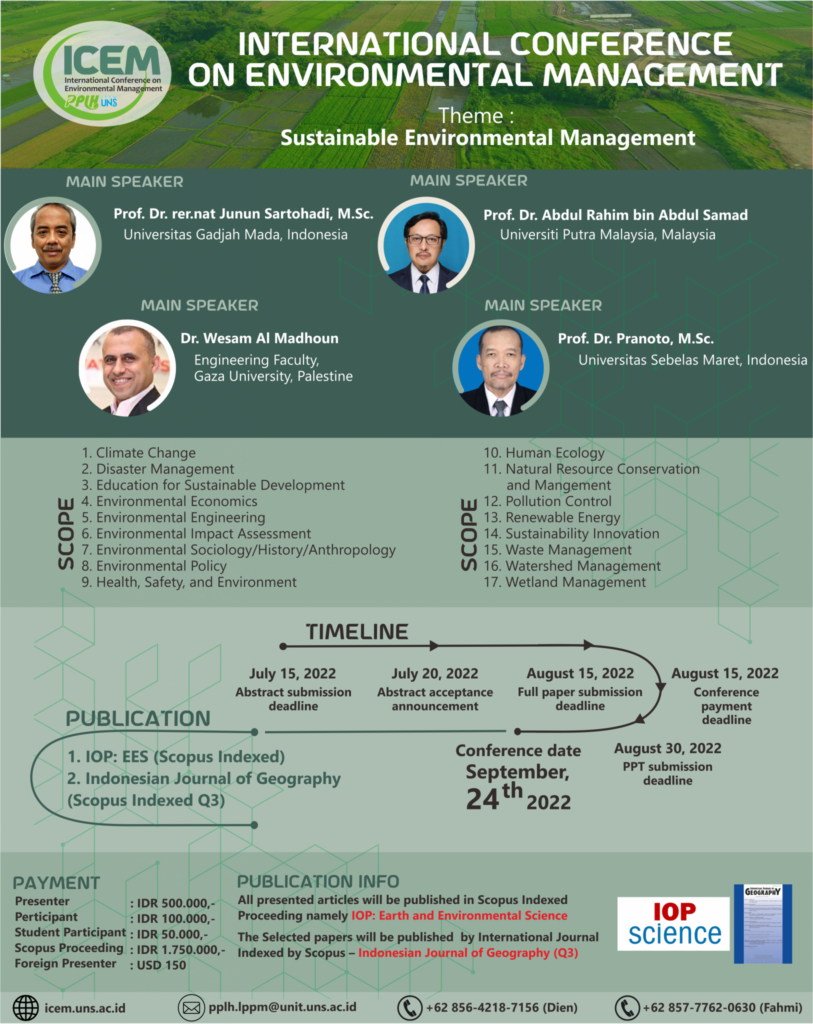
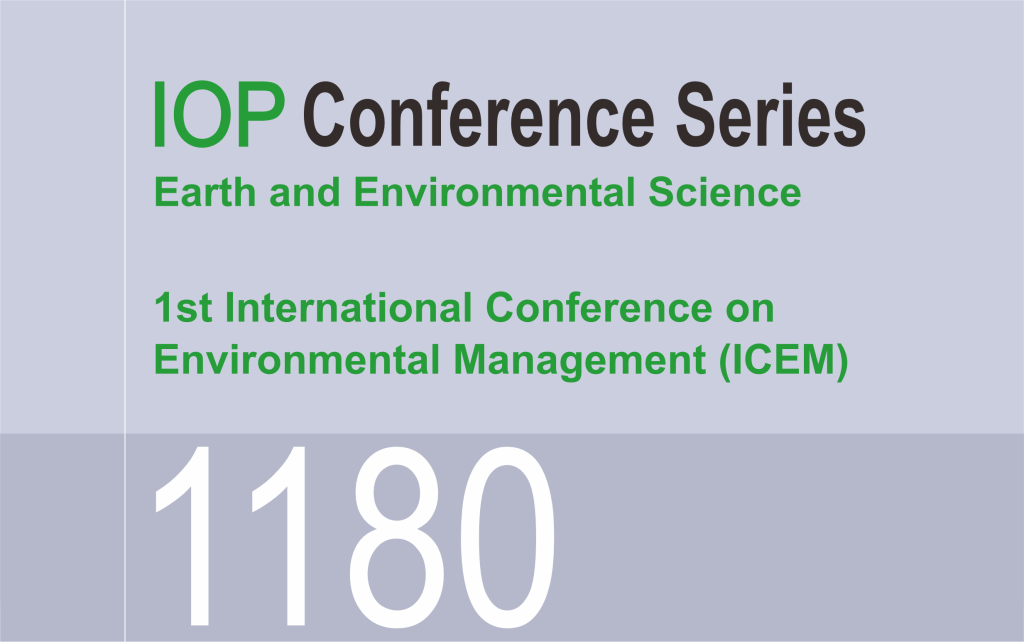
Previous Conference & Publication
1st ICEM 2022
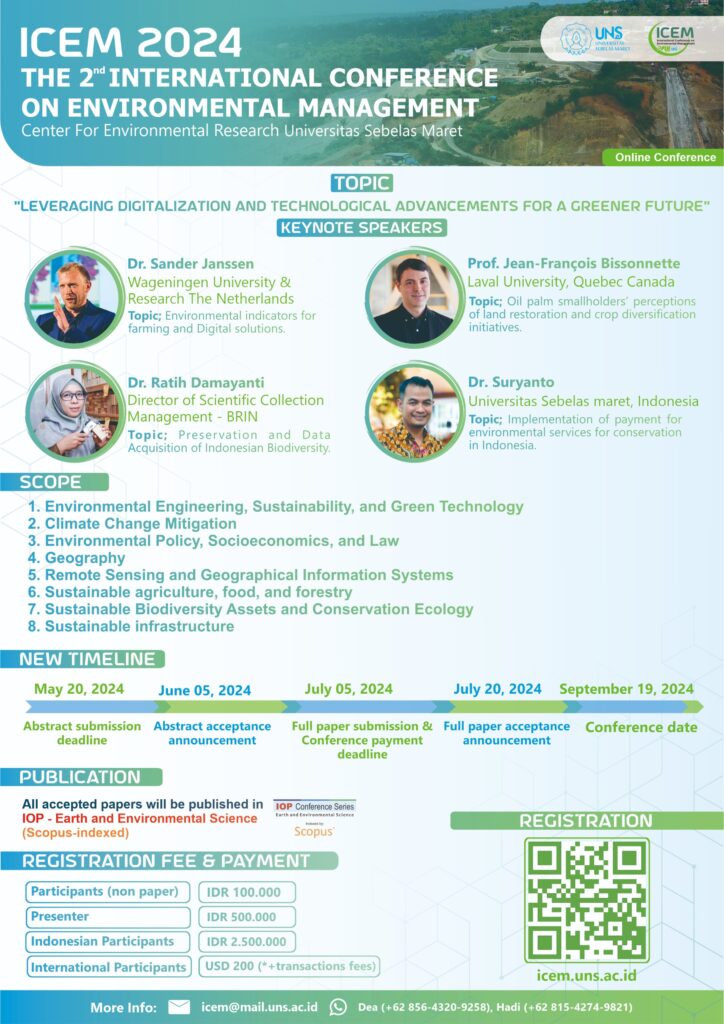
2nd ICEM 2024
Collaborating Partners